Pixel or picture element is a point in a image, or a smallest element in an all points addressable display device so it is the smallest controllable element of a picture represented on a screen. The pixel corresponds to its physical coordinates that pixels are manufactured in a two dimensional grid and are mostly often represented using squares or dots. Each pixel is a sample of an original image that shows more samples typically provide more accurate representations of the original. In colour image systems, a colour is typically represented by three or four components intensities such as red, green and blue or cyan, magenta, yellow, and black. In some of the context such as the camera sensors the term pixel is used to refer a single scalar element of a component representation, more precisely called a photo site in the camera sensor this also includes the fields of a computer or a video game that uses pixel art, the technique has become popular because of the ease with which 2D based graphics this visual perspective around 8-bit or older around to 16-bit for a game system depending on how old the game is.

RGB
The RGB colour model is an additive colour model in which red, green and blue are added together in various ways to reproduce a broad array of colours. The name of the model comes from the initials of the three additive primary colours. red, green and blue. The main purpose of the RGB color model is for the sensing, representation, and display of images in electronic systems, such as televisions and computers, though it has also been used in conventional photography. Before the electronic age, the RGB color model already had a solid theory behind it, based in human perception of colors. RGB is a device-dependent color model: different devices detect or reproduce a given RGB value differently, since the color elements (such as phosphors or dyes) and their response to the individual R, G, and B levels vary from manufacturer to manufacturer, or even in the same device over time. Thus an RGB value does not define the same coloracross devices without some kind of color management. Typical RGB input devices are color TV and video cameras, image scanners, video games, and digital cameras. Typical RGB output devices are TV sets of various technologies (CRT, LCD, plasma, etc.), computer and mobile phone displays, video projectors, multicolor LED displays, and large screens such as JumboTron. Color printers, on the other hand, are not RGB devices, but subtractive color devices (typically CMYK color model). This article discusses concepts common to all the different color spaces that use the RGB color model, which are used in one implementation or another in color image-producing technology.

http://bpiinc.files.wordpress.com/2011/11/rgb.png
http://bpiinc.files.wordpress.com/2011/11/rgb.png
CMYK
The CMYK colour model is a subtractive colour model used in colour printing and is also used to describe the printing process itself. CMYK refers to the four inks used in some colour printing. Cyan, magenta, yellow, and key which is black. Though by print house press operator press manufacturer and press run ink is typical applied in the order of the abbreviation.
http://creativshik.com/wp-content/uploads/2009/12/53-650x380.jpg
RESOLUTION
Put even more simply, more dots and jam the width and the height of the screen and the higher resolution the less dots, the lower resolution. High resolution can be greater but only if you have the type of software for it to keep it up with it, for example if you have like a 40 to 50 inch television and sit close to it on the screen it will seem like it is pix-elated but as you sit further away from it in a distance around the room the picture of the television becomes more clearer and shows more things in detail.
http://creativshik.com/wp-content/uploads/2009/12/53-650x380.jpg
RESOLUTION
Put even more simply, more dots and jam the width and the height of the screen and the higher resolution the less dots, the lower resolution. High resolution can be greater but only if you have the type of software for it to keep it up with it, for example if you have like a 40 to 50 inch television and sit close to it on the screen it will seem like it is pix-elated but as you sit further away from it in a distance around the room the picture of the television becomes more clearer and shows more things in detail.

RASTER IMAGE
A raster image, also called a bitmap, is a way to represent digital images. It can be created in a wide variety of formats, including the familiar .gif, .jpg, and .bmp. The image is represented in a series of bits of information that translate into pixels on the screen. These pixels form points of color that create an overall finished image. When a raster image is created, the image on the screen is converted into pixels. Each pixel is assigned a specific value that determines its color. This format uses the red, green, blue (RGB) color system. An RGB value of 0,0,0 would be black, and the values go all the way through to 256 for each color, allowing the expression of a wide range of values. In photographs with subtle shading, this can be extremely valuable.

https://static.squarespace.com/static/52274fb1e4b0ef52492270bc/52e16b2ce4b00c8b89ca80b1/52e16b2de4b00c8b89ca80bb/1390504749503/1000w/
https://static.squarespace.com/static/52274fb1e4b0ef52492270bc/52e16b2ce4b00c8b89ca80b1/52e16b2de4b00c8b89ca80bb/1390504749503/1000w/
PSD
PSD is Photoshop's native file format, sometimes it's called PDD. PSD or PDD is a widely accepted file format. PSD supports all available image modes (Bitmap, Grayscale, Duotone, Indexed Color, RGB, CMYK, Lab, and Multichannel).

http://fc01.deviantart.net/fs70/i/2013/313/0/5/psd_by_janepham-d6sglpo.png
http://fc01.deviantart.net/fs70/i/2013/313/0/5/psd_by_janepham-d6sglpo.png
BMP
Short for bitmap. It can be pronounced as bump, or B-M-P, also simply a bitmap image. the bmp format is a commonly used raster graphic format for saving image files. It was introduced on the windows platform but is now recognized by many programs on both Macs and PC's.

http://media.moddb.com/images/games/1/23/22052/wip_49_bmp_2.JPG
Short for bitmap. It can be pronounced as bump, or B-M-P, also simply a bitmap image. the bmp format is a commonly used raster graphic format for saving image files. It was introduced on the windows platform but is now recognized by many programs on both Macs and PC's.
http://media.moddb.com/images/games/1/23/22052/wip_49_bmp_2.JPG
GIF
The Graphics Interchange Format is a bitmap image format that was introduced by CompuServe in 1987 and has since come into widespread usage on the world wide web due to its wide support and portability. The format supports up to 8 bit per pixel for each image, allowing a single image to reference its own palette of up to 256 different colours chosen from the 24-bit RGB color space. It also supports animations and allows a separate palette of up to 256 colors for each frame. These palette limitations make the GIF format unsuitable for reproducing colour photographs and other images with continuous colour, but it is well-suited for simpler images such as graphics or logos with solid areas of colour.

http://www.spelljammer.org/monsters/conversions/Giff.jpg
The Graphics Interchange Format is a bitmap image format that was introduced by CompuServe in 1987 and has since come into widespread usage on the world wide web due to its wide support and portability. The format supports up to 8 bit per pixel for each image, allowing a single image to reference its own palette of up to 256 different colours chosen from the 24-bit RGB color space. It also supports animations and allows a separate palette of up to 256 colors for each frame. These palette limitations make the GIF format unsuitable for reproducing colour photographs and other images with continuous colour, but it is well-suited for simpler images such as graphics or logos with solid areas of colour.
http://www.spelljammer.org/monsters/conversions/Giff.jpg
TIFF
Tagged Image File Format Tiff is a computer file format for storing raster graphics images, popular among graphic artists, the publishing industry, and both amateur and professional photographers in general. The format was originally created by the company aldus for the use in desktop publishing. When Adobe Systems acquired aldus they publish version 6 in 1993 of the Tiff specification which dropped the Microsoft reference, tiff remains a published specification under the control of adobe system.

http://www.coolutils.com/img/ConvertPDDtoTIFF1.gif
http://www.coolutils.com/img/ConvertPDDtoTIFF1.gif
JPG
(Joint Photographic Experts Group) In computing, JPEG seen most often with the .jpg or .jpeg file name extension is a commonly used method of lossy compression for digital images, particularly for those images produced by digital photography. The degree of compression can be adjusted, allowing a selectable trade off between storage size and image quality. JPEG typically achieves 10:1 compression with little perceptible loss in image quality.

http://spi1uk.itvnet.lv/upload2/articles/71/712662/images/_origin_Taurina-pieskariens-1-1.jpeg
http://spi1uk.itvnet.lv/upload2/articles/71/712662/images/_origin_Taurina-pieskariens-1-1.jpeg
PNG
Portable Network Graphics PNG,pronounced ping, is a raster graphics file format that supports loss less data compression. PNG was created as an improved, non-patented replacement for Graphics Interchange Format (GIF), and is the most used loss less image compression format on the Internet. PNG supports palette-based images with palettes of 24-bit RGB or 32-bit RGBA colours,gray scale images with or without alpha channel, and full-color non-palette-based RGB images with or without alpha channel. PNG was designed for transferring images on the Internet, not for professional-quality print graphics, and therefore does not support non-RGB colour spaces such as CMYK.

http://www.iconeasy.com/icon/thumbnails/System/Radium/Png%20file%20Icon.jpg
http://www.iconeasy.com/icon/thumbnails/System/Radium/Png%20file%20Icon.jpg
VECTOR IMAGES
Vector graphics is the use of geometrical primitives such as points, lines, curves, and shapes or polygons all of which are based on mathematical expressions to represent images in computer graphics. Vector graphics are based on vectors also called paths, which lead through locations called control points or nodes. Each of these points has a definite position on the x and y axes of the work plane and determines the direction of the path; further, each path may be assigned a stroke color, shape, thickness, and fill. These properties don't increase the size of vector graphics files in a substantial manner, as all information resides in the document's structure, which describes solely how the vector should be drawn.

https://software.intel.com/sites/default/files/m/d/d/a/8/0/29298-figure-2.jpg
https://software.intel.com/sites/default/files/m/d/d/a/8/0/29298-figure-2.jpg
EPS
Encapsulated PostScript (EPS) is a DSC conforming postscript document with additional restrictions which is intended to be usable as a graphics file format. In other words, EPS files are more-or-less self-contained, reasonably predictable PostScript documents that describe an image or drawing and can be placed within another PostScript document. Simply, an EPS file is a PostScript program, saved as a single file that includes a low-resolution preview "encapsulated" inside of it, allowing some programs to display a preview on the screen.At minimum, an EPS file contains a bounding box DSC comment, describing the rectangle containing the image described by the EPS file. Applications can use this information to lay out the page, even if they are unable to directly render the PostScript inside.

http://www.softfields.com/images/eps_15.jpg
WMF
Windows Metafile (WMF) is an image file format originally designed for Microsoft Windows in the 1990s. Windows Metafiles are intended to be portable between applications and may contain both vector graphics and bitmap components. It acts in a similar manner to SVG files.
Essentially, a WMF file stores a list of function calls that have to be issued to the Windows Graphics Device Interface(GDI) layer to display an image on screen. Since some GDI functions accept pointers to callback functions for error handling, a WMF file may erroneously include executable code.
WMF is a 16 bit format introduced in windows 3.0. It is the native vector format for Microsoft Office applications such as Word, PowerPoint, and Publisher. As of 2014[update] revision 11 of the Windows Metafile Format specification is available for online reading or download as PDF.

http://www.download.net.pl/upload/files/gallery/old/9c/9/c/7955121fae1e7869803990c9ceb20c81.gif.gif
FLA
Files that contain the .fla file extension are files that are used by the Adobe Flash application. The Adobe Flash application was previously referred to as Macromedia Flash. Adobe Systems acquired Macromedia in 2005. Most Web browsers can support the Adobe Flash feature. Files that contain the .fla file extension store movies or animation files that have been created with the Adobe Flash application. These files are often saved as SWF files for use on the Internet. The FLA file is a raw editable file that is saved by the Flash software application. The SWF file is the compressed file that is created from the FLA file for use on the Web.

http://gdn9.com/userfiles/image/2011/September/adobe-flash-games-go-3D.jpg
SVG
Scalable Vector Graphics (SVG) is an XML-based vector image format for two-dimensional graphics with support for interactivity and animation. The SVG specification is an open standard developed by the World Wide Web Consortium (W3C) since 1999.
SVG images and their behaviors are defined in XML text files. This means that they can be searched, indexed, scripted, and compressed. As XML files, SVG images can be created and edited with any text editor, but are more often created with drawing software.
All major modern web browsers including Mozilla Firefox, Internet Explorer, Google Chrome, Opera, and Safari have at least some degree of SVG rendering support.

http://blogs.msdn.com/cfs-filesystemfile.ashx/__key/communityserver-blogs-components-weblogfiles/00-00-01-10-46-metablogapi/4784.CanvasVsSVG_5F00_325C4B24.jpg
AI
Adobe Illustrator Artwork (AI) is a proprietary file format developed by Adobe Systems for representing single-page vector-based drawings in either the EPS or PDFformats. The .ai filename extension is used by Adobe Illustrator.
Adobe Illustrator Artwork (AI) is a proprietary file format developed by Adobe Systems for representing single-page vector-based drawings in either the EPS or PDFformats. The .ai filename extension is used by Adobe Illustrator.
The AI file format was originally a native format called PGF. PDF compatibility is achieved by embedding a complete copy of the PGF data within the saved PDF format file. This format is not related to .pgf using the same name Progressive Graphics Format. The same “dual path” approach as for PGF is used when saving EPS-compatible files in recent versions of Illustrator. Early versions of the AI file format are true EPS files with a restricted, compact syntax, with additional semantics represented by Illustrator-specific DSC comments that conform to DSC's Open Structuring Conventions. These files are identical to their corresponding Illustrator EPS counterparts, but with the EPS procsets (procedure sets) omitted from the file and instead externally referenced using %%Include directive

http://img2.wikia.nocookie.net/__cb20090223222424/totalwar/images/a/a6/Etw01.jpg
Cross-platform Images Using PDF
Portable Document Format (PDF) is a file format used to present documents in a manner independent of application software, hardware, and operating systems. Each PDF file encapsulates a complete description of a fixed-layout flat document, including the text, fonts, graphics, and other information needed to display it. In 1991, Adobe Systems co-founder John Warnock outlined a system called "Camelot" that evolved into PDF.

http://www.all-new-games.ru/uploads/posts/2013-06/1371802639_skulls-of-the-shogun-1.png
Compression Lossy and Lossless
Lossless and lossy compression are terms that describe whether or not, in the compression of a file, all original data can be recovered when the file is uncompressed. With lossless compression, every single bit of data that was originally in the file remains after the file is uncompressed. All of the information is completely restored. This is generally the technique of choice for text or spreadsheet files, where losing words or financial data could pose a problem. The Graphics Interchange File (GIF) is an image format used on the Web that provides lossless compression.
On the other hand, lossy compression reduces a file by permanently eliminating certain information, especially redundant information. When the file is uncompressed, only a part of the original information is still there (although the user may not notice it). Lossy compression is generally used for video and sound, where a certain amount of information loss will not be detected by most users. The JPEG image file, commonly used for photographs and other complex still images on the Web, is an image that has lossy compression. Using JPEG compression, the creator can decide how much loss to introduce and make a trade-off between file size and image quality.

https://blogger.googleusercontent.com/img/b/R29vZ2xl/AVvXsEjzKadqKu5uUfA8oMqvNlak35oUWpW3T_aJuug_JFpxXhQ48_e_0oW11plkJeRYUoWZFHAq3QFa7fUVN1RMp7EGbypcz3WpOvOIWVLYDEo2dkDQv9qg64ou6kv1MitJ3fwm9gGeajXVgf8/s1600/catcompare2.jpg
Image Capture Devices - Scanner
In computing, an image scanner often abbreviated to just scanner, although the term is ambiguous out of context (barcode scanner, CAT scanner, etc.) is a device that optically scans images, printed text, handwriting, or an object, and converts it to a digital image. Commonly used in offices are variations of the desktop flatbed scanner where the document is placed on a glass window for scanning. Hand-held scanners, where the device is moved by hand, have evolved from text scanning "wands" to 3D scanners used for industrial design, reverse engineering, test and measurement, orthotics, gaming and other applications. Mechanically-driven scanners that move the document are typically used for large-format documents, where a flatbed design would be impractical.

http://cheap3d-printer.com/wp-content/plugins/RSSPoster_PRO/cache/5ad61_dujfiedermxuoznfq2xz.jpg
Digital Camera
A digital camera (or digicam) is a camera that encodes digital images and videos digitally and stores them for later reproduction. Most cameras sold today are digital, and digital cameras are incorporated into many devices ranging from PDAs and mobile phones (called camera phones) to vehicles.
Digital and film cameras share an optical system, typically using a lens with a variable diaphragm to focus light onto an image pickup device. The diaphragm and shutter admit the correct amount of light to the imager, just as with film but the image pickup device is electronic rather than chemical. However, unlike film cameras, digital cameras can display images on a screen immediately after being recorded, and store and delete images from memory. Many digital cameras can also record moving videos with sound. Some digital cameras can crop and stitch pictures and perform other elementary image editing.

http://www.alfabetajuega.com/multimedia/imagenes/201305/41786.infamous_second_son_ciudadanos_3.jpg
Tablet
A tablet computer, or simply tablet, is a mobile computer with display, circuitry and battery in a single unit. Tablets are equipped with sensors, including cameras, microphone, accelerometer and touchscreen, with finger or stylus gestures replacing computer mouse and keyboard. Tablets may include physical buttons, e.g., to control basic features such as speaker volume and power and ports for network communications and to charge the battery. An on-screen, pop-up virtual keyboard is usually used for typing. Tablets are typically larger than smart phones or personal digital assistants at 7 inches (18 cm) or larger, measured diagonally.
Tablets can be separated into several categories, according to the presence and physical appearance of a keyboard. Slates and Booklets does not have a physical keyboard and a text input typically is performed through the use of a virtual keyboard, projected on a touchscreen-enabled display. Hybrids and Convertibles do have physical keyboards, although the virtual keyboard feature is typically also available with these devices.

http://it-stream.ru/wp-content/uploads/sites/2/2014/07/wpid-NVIDIA-SHIELD-tablet-and-wireless-controller.jpg
SmartPhone
A camera phone is a mobile phone which is able to capture photographs and high-definition video. Since early in the 21st century the majority of mobile phones in use are camera phones.
Most camera phones are simpler than separate digital cameras. Their usual fixed-focus lenses and smaller sensors limit their performance in poor lighting. Lacking a physical shutter, most have a long shutter lag. Flash, where present, is usually weak. Optical zoom and tripod screws are rare. Some also lack a USB connection, removable memory card, or other way of transferring their pictures more quickly than by the phone's inherent communication feature.

http://technologyinsider.co.uk/wp-content/uploads/2014/08/Leave-digital-gifts-in-physical-locations-with-Traces-app.jpg
Optimizing
In computer science, program optimization or software optimization is the process of modifying a software system to make some aspect of it work more efficiently or use fewer resources. In general, a computer program may be optimized so that it executes more rapidly, or is capable of operating with less memory storage or other resources, or draw less power.

http://i.vimeocdn.com/video/482345546_1280x720.jpg
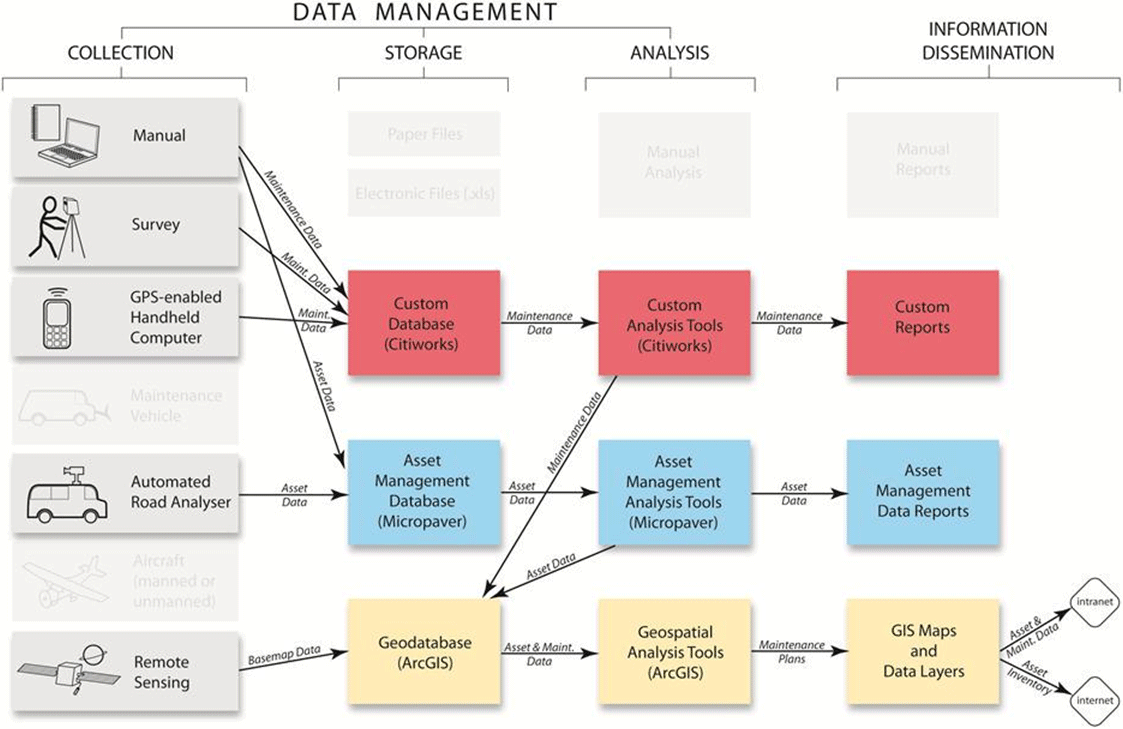
Storage and Asset Management
asset management (DAM) consists of management tasks and decisions surrounding the ingestion, annotation, cataloguing, storage, retrieval and distribution of digital assets.
Digital photographs, animations, videos and music exemplify the target areas of media asset management (a sub-category of DAM). Digital asset management systems (DAMS) include computer software and hardware systems that aid in the process of digital asset management.





No comments:
Post a Comment